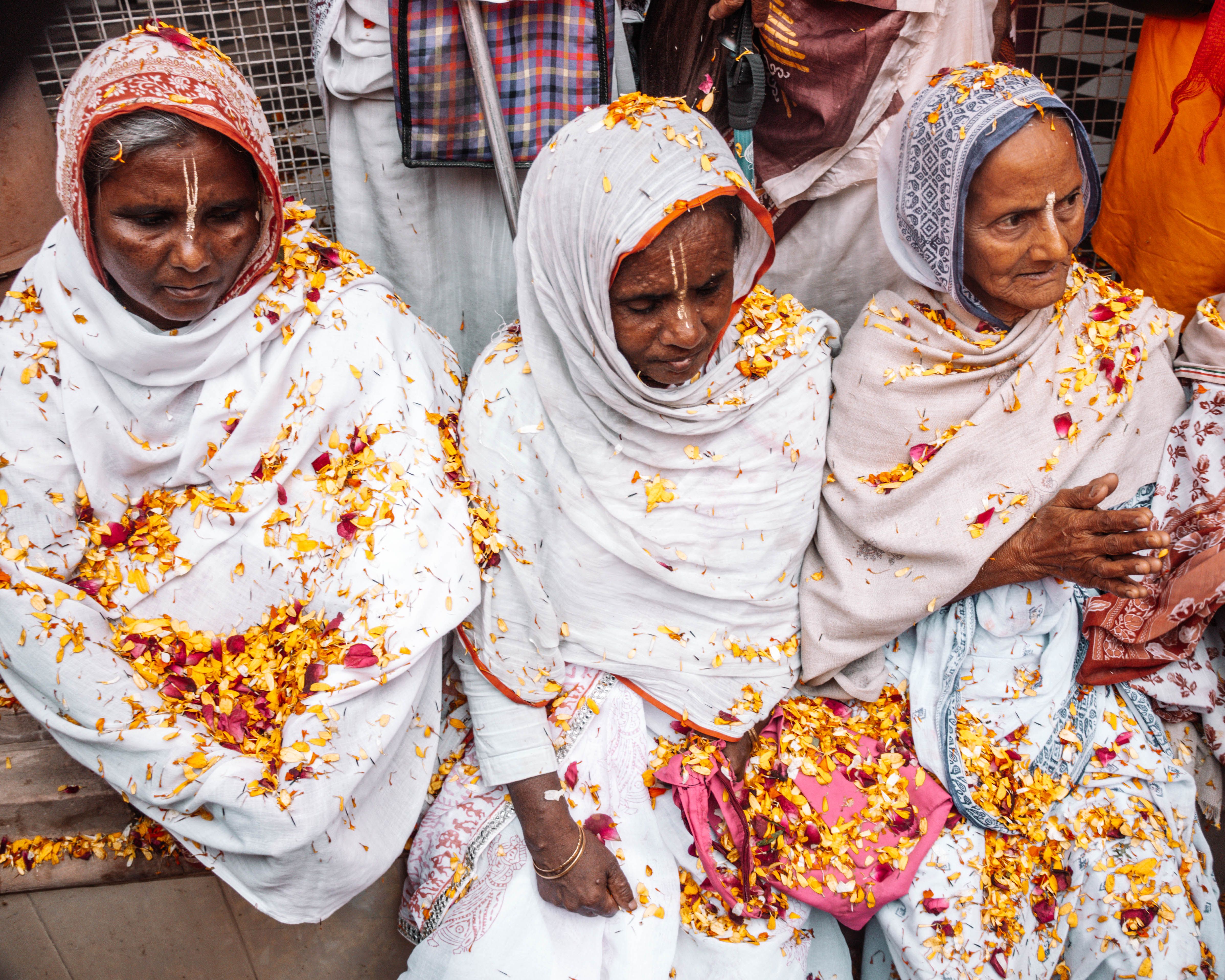
Refusing to Live in Black & White is one woman’s account of widowhood. It was never meant to be the whole picture. It is not.
At the time of the 2011 Census, India was home to 43 million widowed women, against 12 million widowed men, a gap so wide it is not fully explained by mortality alone. According to the Government of India’s own figures, 7.4% of Indian women were widowed in 2011, compared to 2% of Indian men. Widowers remarry far more often, and far more easily, than widows do, a pattern well documented across decades of Indian demographic research, though the exact figures vary by study and region.
India’s central pension scheme pays a widow between the ages of 40 and 79 exactly 300 rupees a month, rising to 500 rupees only after she turns 80. A 2010 study found that just 25% of eligible widows ever receive any pension at all. In Vrindavan, home to more than 20,000 widows, recent field reporting found that fewer than a third of the women interviewed received any pension, and only one in ten received a widow’s pension specifically.
Inheritance law grants Indian widows real rights, but rights on paper and rights in practice are often two different things. Even where a widow legally owns land, she may not be able to use it without her husband’s relatives, and that help is rarely free. Education does not fully solve this either. One study, which interviewed widows across Hindu, Muslim, and Christian households and multiple caste groups in a rural community, found a narrow gap in literacy between men and women in the state — yet cited data showing three out of four elderly women there owned no financial assets in their own name at all.
Having a right, and being able to use it, are not the same thing.
Refusing to Live in Black & White is only one story. The numbers above are part of the bigger picture.
References
Government of India, Census of India 2011, cited in: Reed, H. “The labor force participation of Indian women before and after widowhood.” Demographic Research, 2020. https://pmc.ncbi.nlm.nih.gov/articles/PMC8323827/
Pal, A., Kim, R. and Subramanian, S.V. “Prevalence of Widowhood Across States and Union Territories in India, 1993–2021: A Repeated Cross-Sectional Study.” Journal of Global Health, 16, 04068, 2026. https://doi.org/10.7189/jogh.16.04068
Indira Gandhi National Widow Pension Scheme, Ministry of Rural Development, Government of India, via UMANG official portal. https://web.umang.gov.in/landing/scheme/detail/indira-gandhi-national-widow-pension-scheme_ignwps.html
UNIFEM, 2010 report on multidimensional poverty, cited in: “Despite Public Schemes, Vrindavan’s Widows Cannot Afford A Life of Dignity.” BehanBox, January 2025. https://behanbox.com/2025/01/07/despite-public-schemesvrindavans-widows-cannot-afford-a-life-of-dignity/
Atwal, J. “Socio-Economic Structure of Widowhood in India: Past and Present.” Current Research Journal of Social Sciences and Humanities, 6(1), 2023. https://journalofsocialsciences.org/vol6no1/socio-economic-structure-of-widowhood-in-india–past-and-present/
Mohindra, K.S., Haddad, S. & Narayana, D. Debt, shame, and survival: becoming and living as widows in rural Kerala, India. BMC Int Health Hum Rights 12, 28 (2012). https://doi.org/10.1186/1472-698X-12-28